C.A. Jacobson: North Dakota’s Frontier Sentinel and His Quest for Justice
Third in the Frontier Lawman Series
Published in the April 2026 issue of The Cowboy Chronicle, official publication of the
North Dakota Cowboy Hall of Fame
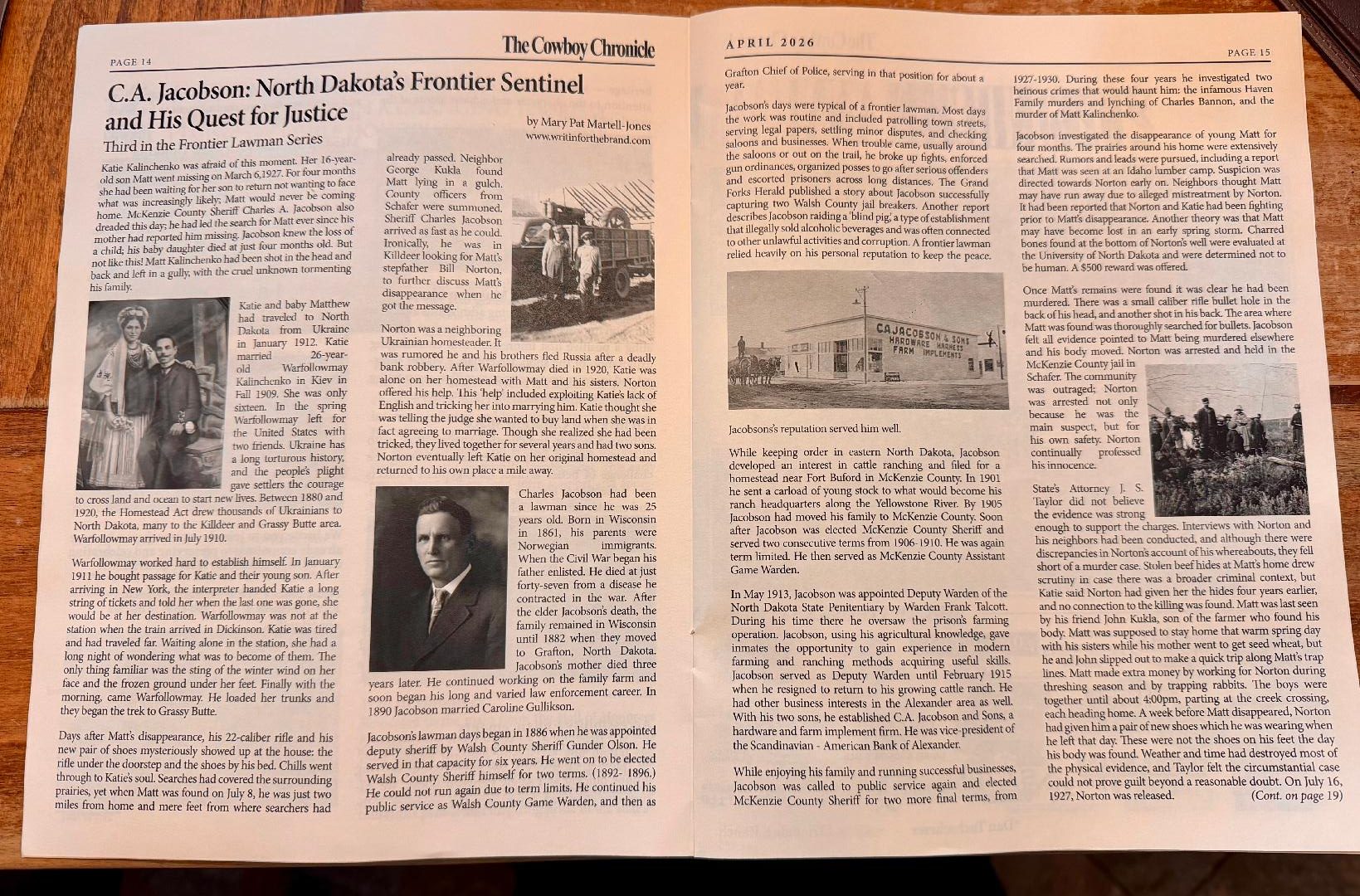
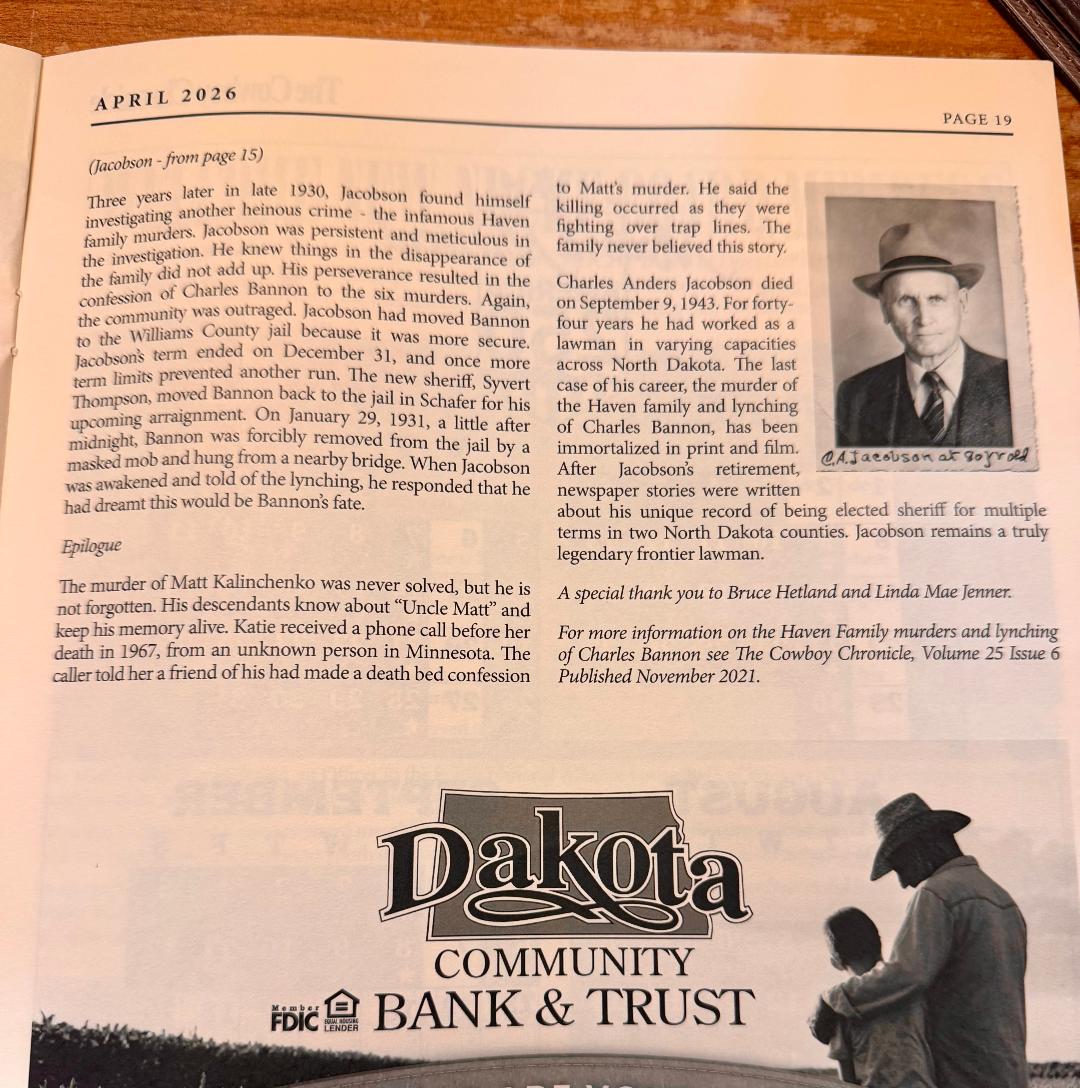
Katie Kalinchenko was afraid of this moment. Her 16-year-old son Matt went missing on March 6,1927. For four months she had been waiting for her son to return not wanting to face what was increasingly likely; Matt would never be coming home. McKenzie County Sheriff Charles A. Jacobson also dreaded this day; he had led the search for Matt ever since his mother had reported him missing. Jacobson knew the loss of a child; his baby daughter died at just four months old. But not like this! Matt Kalinchenko had been shot in the head and back and left in a gully, with the cruel unknown tormenting his family.
Katie and baby Matthew had traveled to North Dakota from Ukraine in January 1912. Katie married 26-year-old Warfollowmay Kalinchenko in Kiev in Fall 1909. She was only sixteen. In the spring Warfollowmay left for the United States with two friends. Ukraine has a long torturous history, and the people’s plight gave settlers the courage to cross land and ocean to start new lives. Between 1880 and 1920, the Homestead Act drew thousands of Ukrainians to North Dakota, many to the Killdeer and Grassy Butte area. Warfollowmay arrived in July 1910.
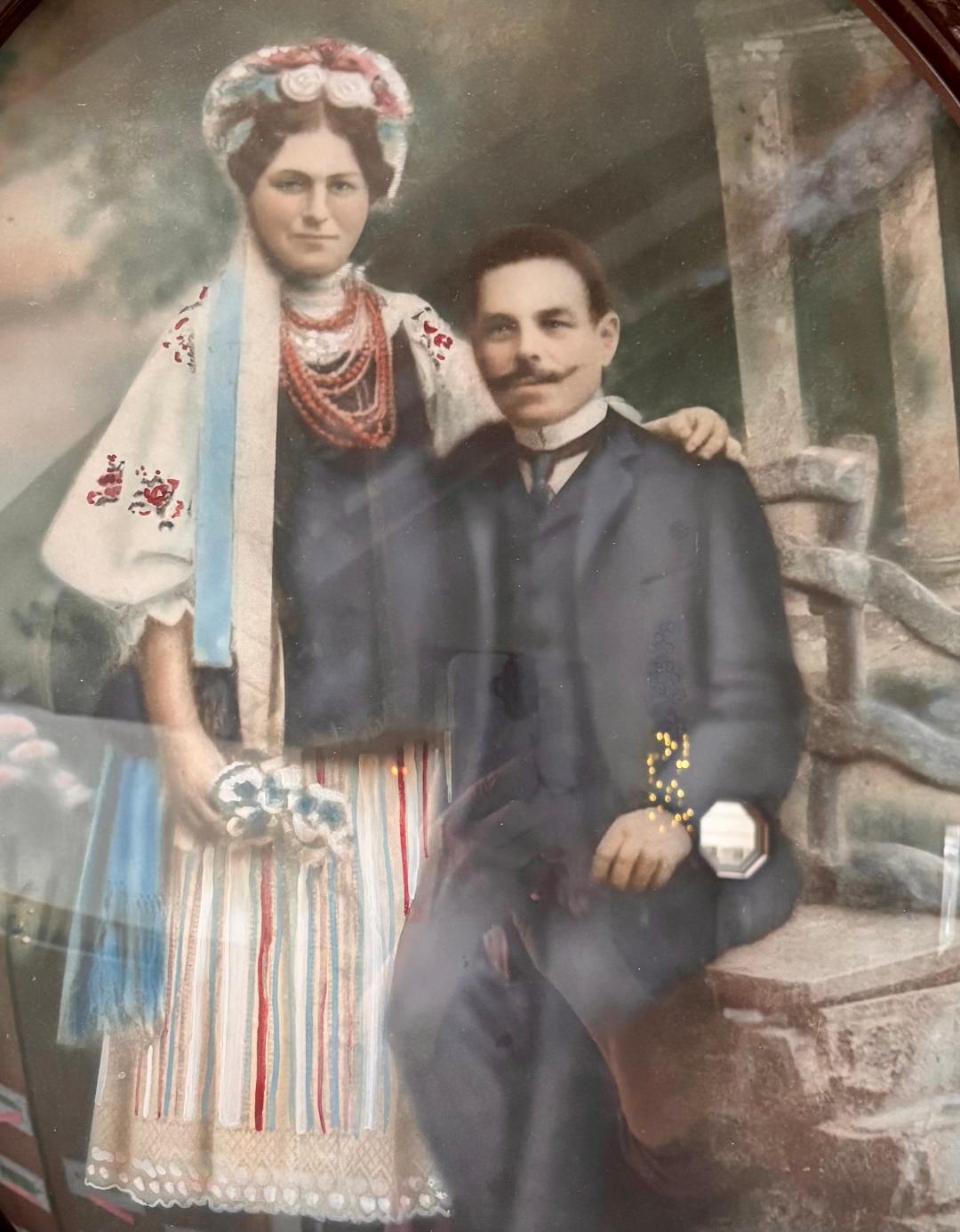
Warfollowmay worked hard to establish himself. In January 1911 he bought passage for Katie and their young son. After arriving in New York, the interpreter handed Katie a long string of tickets and told her when the last one was gone, she would be at her destination. Warfollowmay was not at the station when the train arrived in Dickinson. Katie was tired and had traveled far. Waiting alone in the station, she had a long night of wondering what was to become of them. The only thing familiar was the sting of the winter wind on her face and the frozen ground under her feet. Finally with the morning, came Warfollowmay. He loaded her trunks and they began the trek to Grassy Butte.
Days after Matt’s disappearance, his 22-caliber rifle and his new pair of shoes mysteriously showed up at the house: the rifle under the doorstep and the shoes by his bed. Chills went through to Katie’s soul. Searches had covered the surrounding prairies, yet when Matt was found on July 8, he was just two miles from home and mere feet from where searchers had already passed. Neighbor George Kukla found Matt lying in a gulch. County officers from Schafer were summoned. Sheriff Charles Jacobson arrived as fast as he could. Ironically, he was in Killdeer looking for Matt’s stepfather Bill Norton, to further discuss Matt’s disappearance when he got the message
Norton was a neighboring Ukrainian homesteader. It was rumored he and his brothers fled Russia after a deadly bank robbery. After Warfollowmay died in 1920, Katie was alone on her homestead with Matt and his sisters. Norton offered his help. This ‘help’ included exploiting Katie’s lack of English and tricking her into marrying him. Katie thought she was telling the judge she wanted to buy land when she was in fact agreeing to marriage. Though she realized she had been tricked, they lived together for several years and had two sons. Norton eventually left Katie on her original homestead and returned to his own place a mile away.
Charles Jacobson had been a lawman since he was 25 years old. Born in Wisconsin in 1861, his parents were Norwegian immigrants. When the Civil War began his father enlisted. He died at just forty-seven from a disease he contracted in the war. After the elder Jacobson’s death, the family remained in Wisconsin until 1882 when they moved to Grafton, North Dakota. Jacobson’s mother died three years later. He continued working on the family farm and soon began his long and varied law enforcement career. In 1890 Jacobson married Caroline Gullikson.
Jacobson’s lawman days began in 1886 when he was appointed deputy sheriff by Walsh County Sheriff Gunder Olson. He served in that capacity for six years. He went on to be elected Walsh County Sheriff himself for two terms. (1892- 1896.) He could not run again due to term limits. He continued his public service as Walsh County Game Warden, and then as Grafton Chief of Police, serving in that position for about a year.
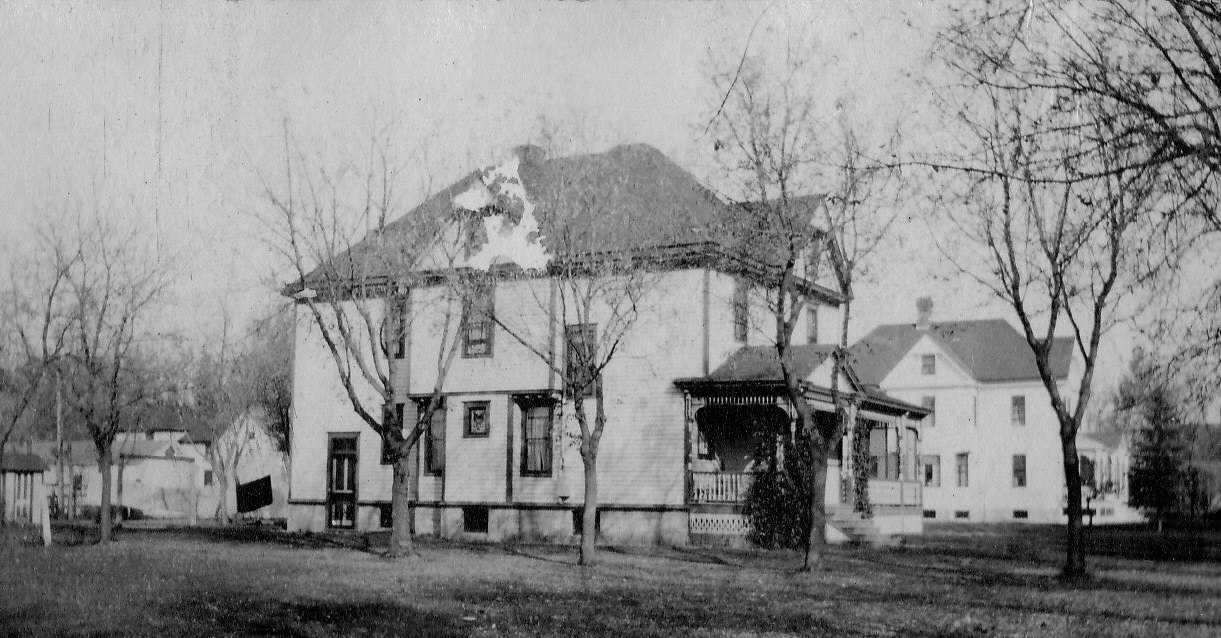
Jacobson’s days were typical of a frontier lawman. Most days the work was routine and included patrolling town streets, serving legal papers, settling minor disputes, and checking saloons and businesses. When trouble came, usually around the saloons or out on the trail, he broke up fights, enforced gun ordinances, organized posses to go after serious offenders and escorted prisoners across long distances. The Grand Forks Herald published a story about Jacobson successfully capturing two Walsh County jail breakers. Another report describes Jacobson raiding a ‘blind pig,’ a type of establishment that illegally sold alcoholic beverages and was often connected to other unlawful activities and corruption. A frontier lawman relied heavily on his personal reputation to keep the peace. Jacobsons’s reputation served him well.
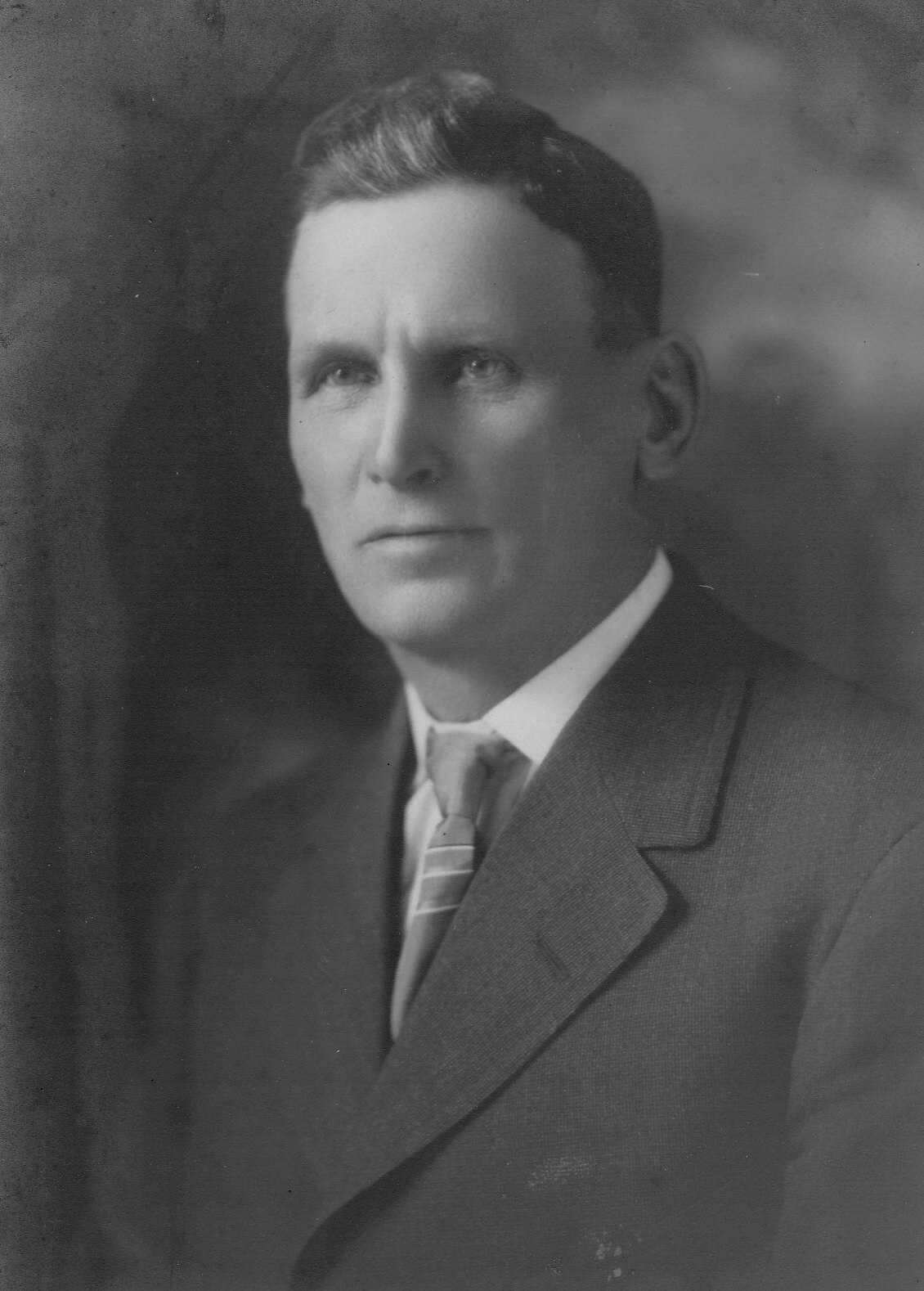
Once Matt’s remains were found it was clear he had been murdered. There was a small caliber rifle bullet hole in the back of his head, and another shot in his back. The area where Matt was found was thoroughly searched for bullets. Jacobson felt all evidence pointed to Matt being murdered elsewhere and his body moved. Norton was arrested and held in the McKenzie County jail in Schafer. The community was outraged; Norton was arrested not only because he was the main suspect, but for his own safety. Norton continually professed his innocence.
While keeping order in eastern North Dakota, Jacobson developed an interest in cattle ranching and filed for a homestead near Fort Buford in McKenzie County. In 1901 he sent a carload of young stock to what would become his ranch headquarters along the Yellowstone River. By 1905 Jacobson had moved his family to McKenzie County. Soon after Jacobson was elected McKenzie County Sheriff and served two consecutive terms from 1906-1910. He was again term limited. He then served as McKenzie County Assistant Game Warden.
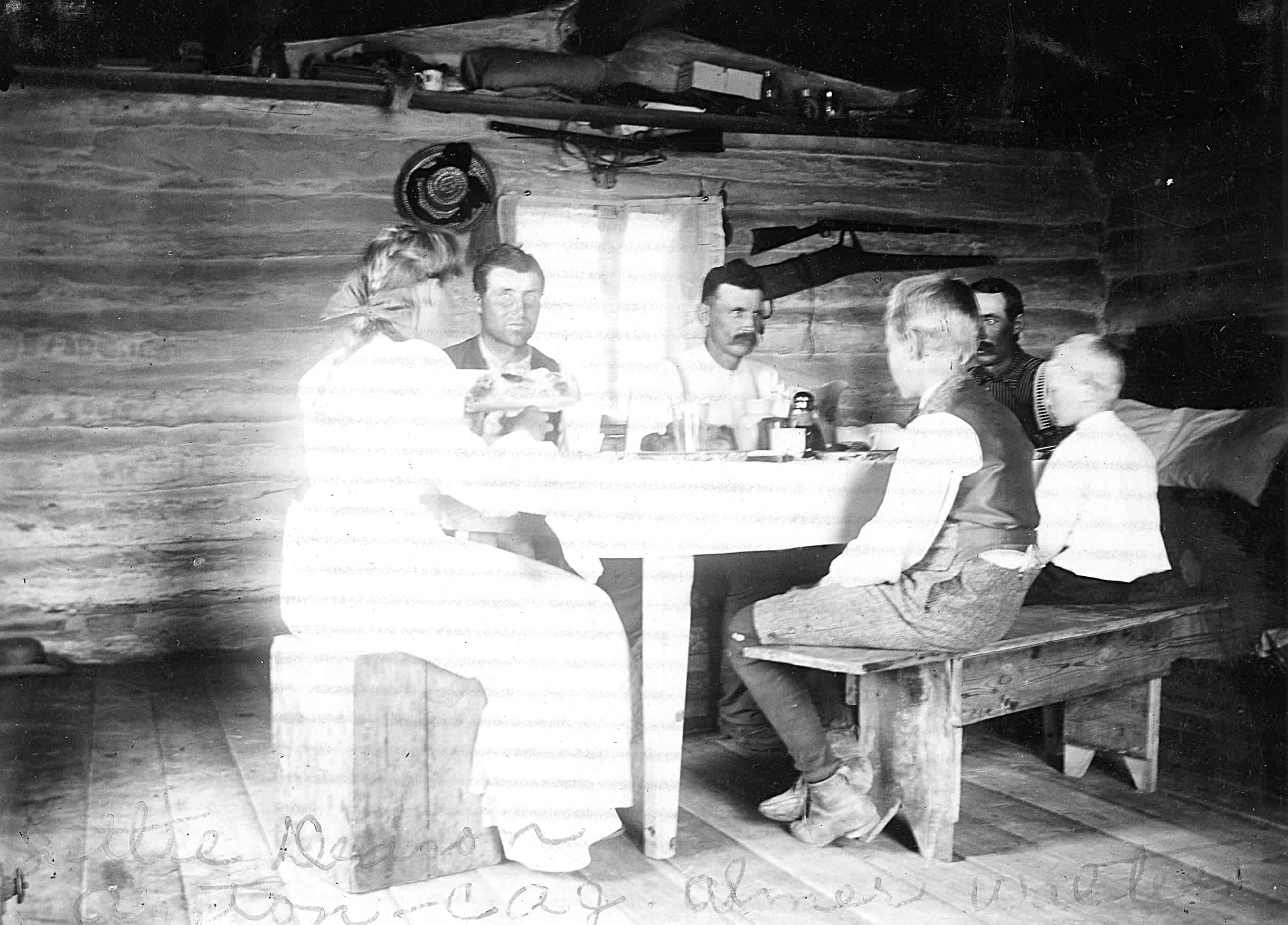
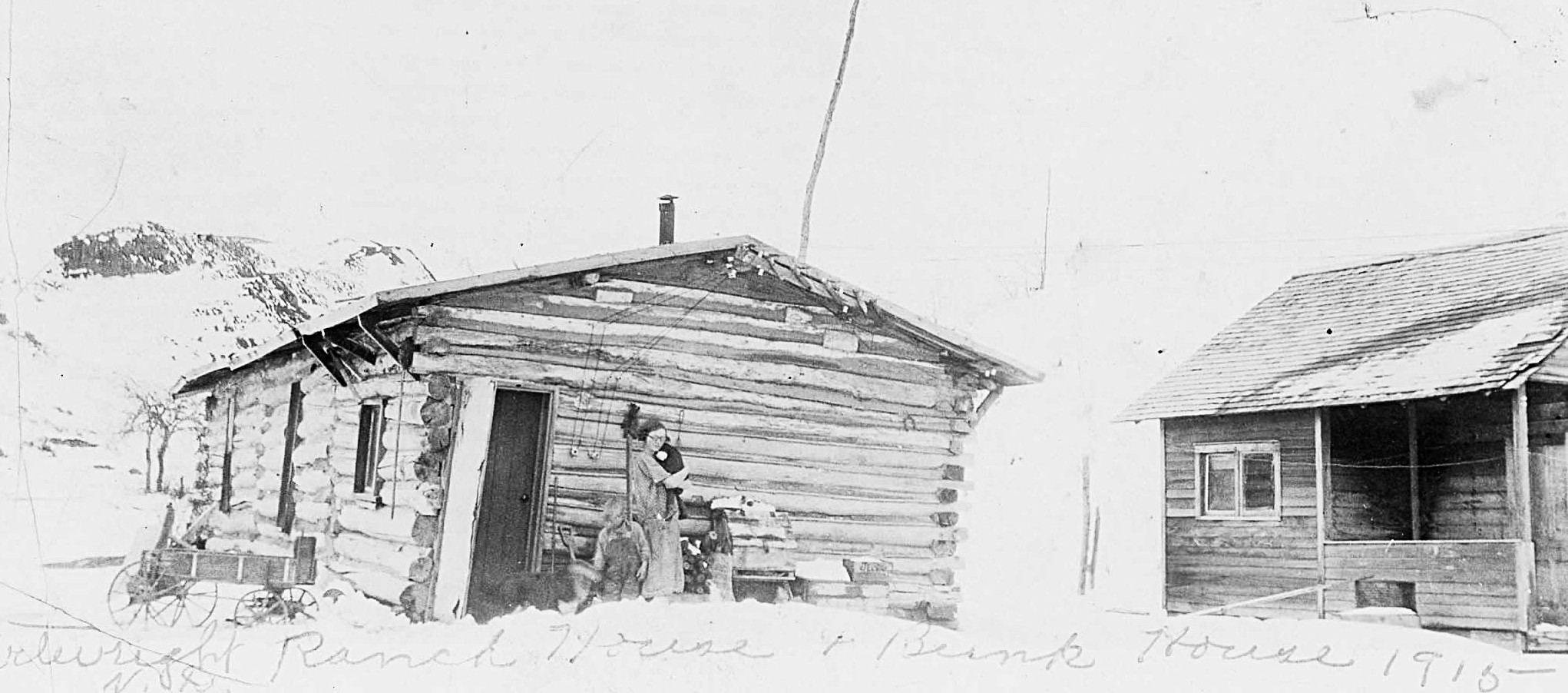
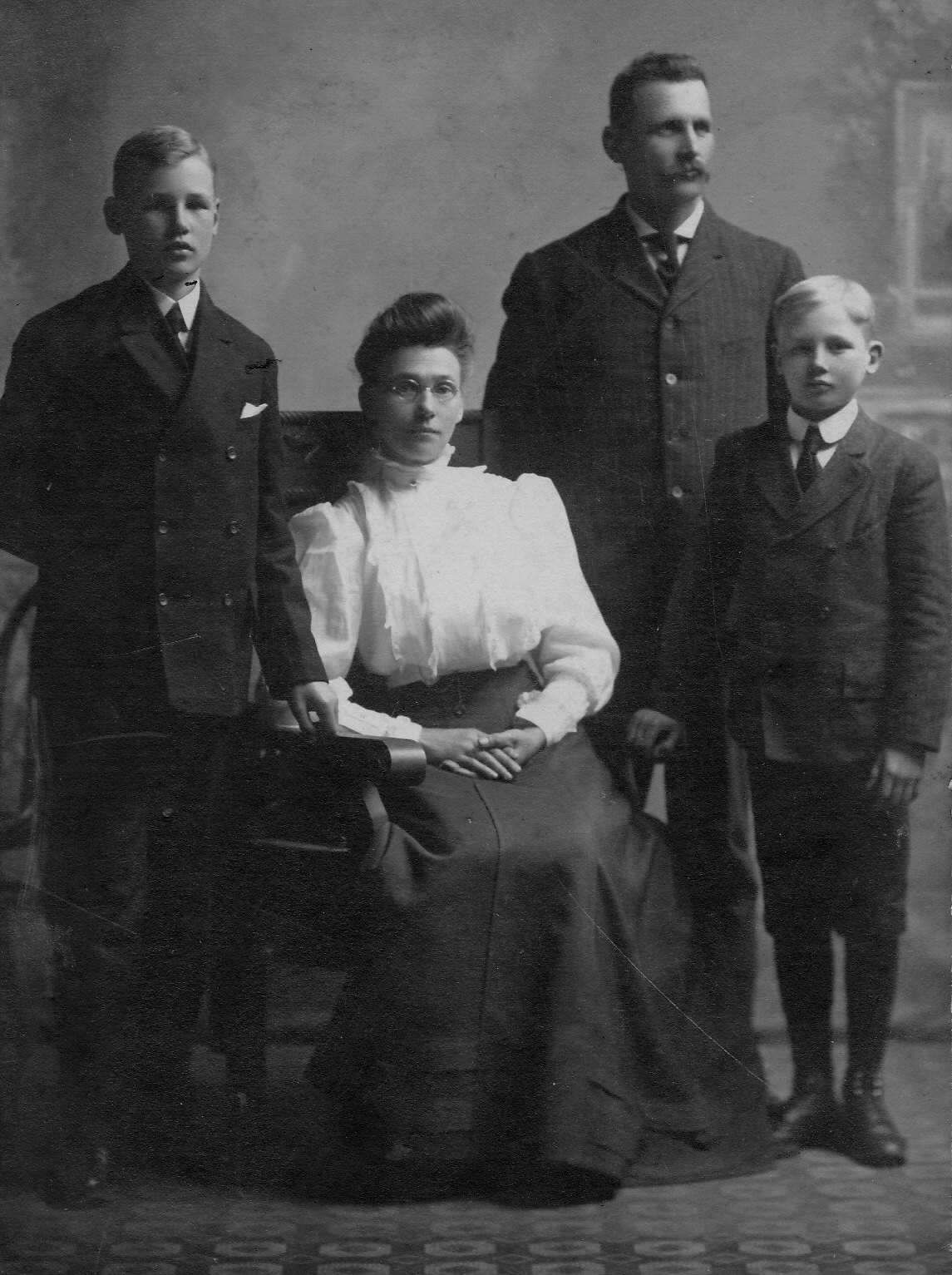
In May 1913, Jacobson was appointed Deputy Warden of the North Dakota State Penitentiary by Warden Frank Talcott. During his time there he oversaw the prison’s farming operation. Jacobson, using his agricultural knowledge, gave inmates the opportunity to gain experience in modern farming and ranching methods acquiring useful skills. Jacobson served as Deputy Warden until February 1915 when he resigned to return to his growing cattle ranch. He had other business interests in the Alexander area as well. With his two sons, he established C.A. Jacobson and Sons, a hardware and farm implement firm. He was vice-president of the Scandinavian – American Bank of Alexander.
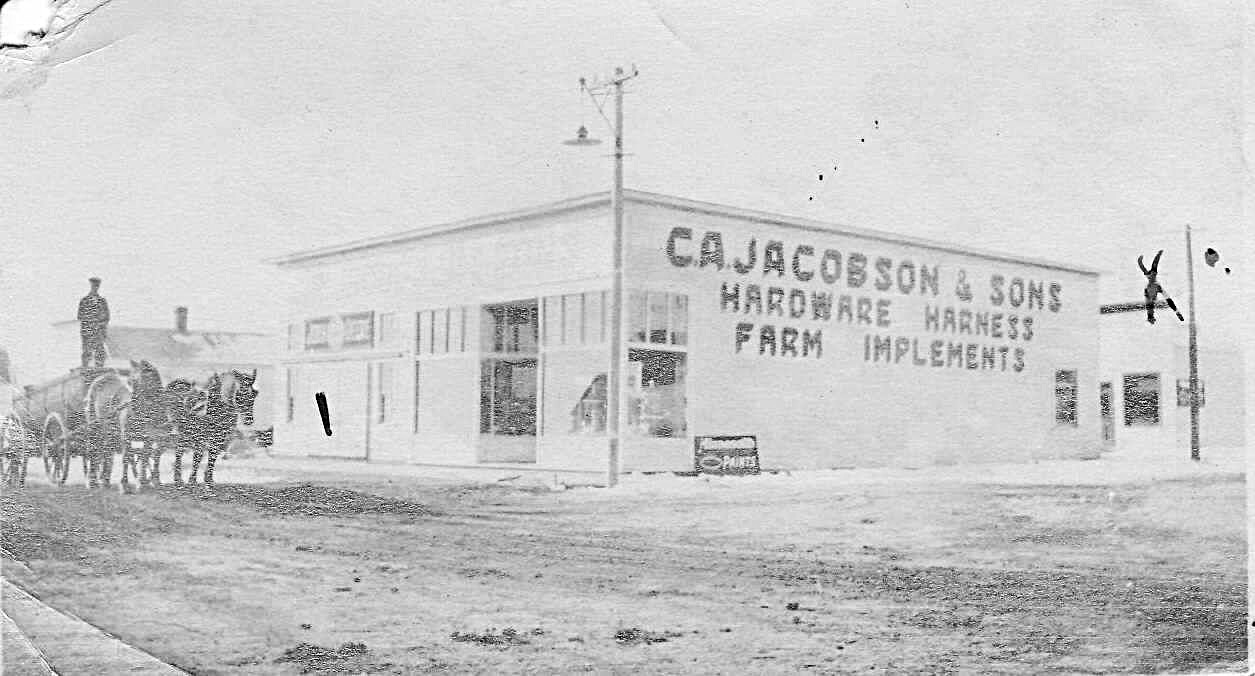
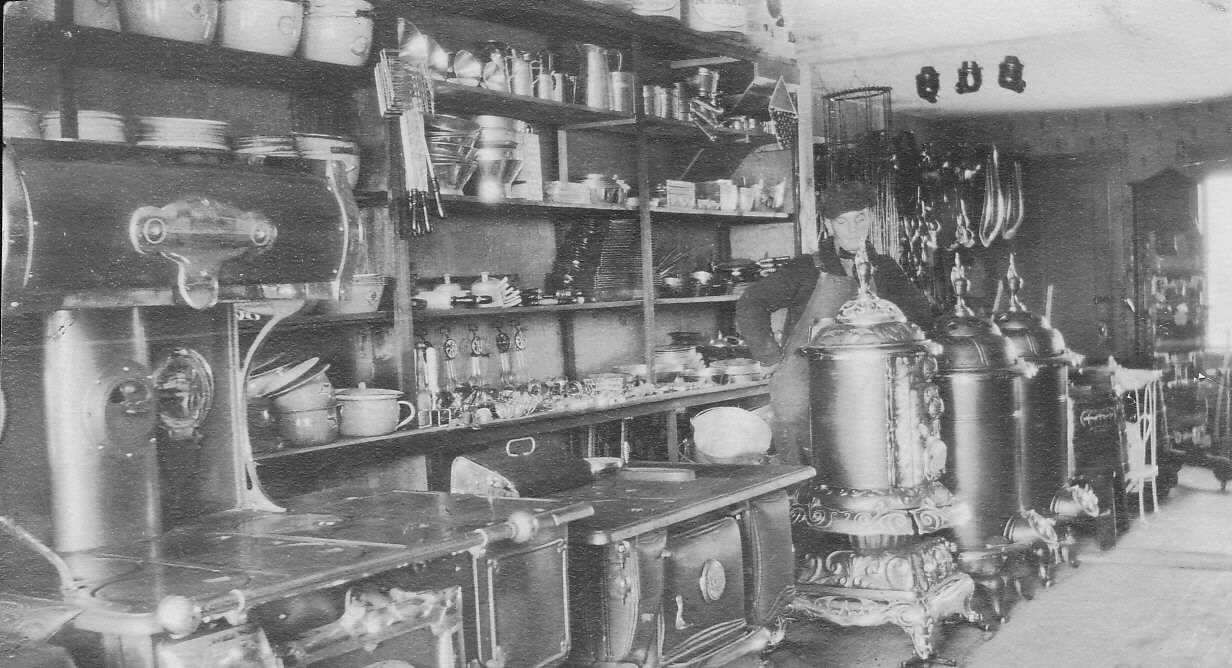
While enjoying his family and running successful businesses, Jacobson was called to public service again and elected McKenzie County Sheriff for two more final terms, from 1927-1930. During these four years he investigated two heinous crimes that would haunt him: the infamous Haven Family murders and lynching of Charles Bannon, and the murder of Matt Kalinchenko.
Jacobson investigated the disappearance of young Matt for four months. The prairies around his home were extensively searched. Rumors and leads were pursued, including a report that Matt was seen at an Idaho lumber camp. Suspicion was directed towards Norton early on. Neighbors thought Matt may have run away due to alleged mistreatment by Norton. It had been reported that Norton and Katie had been fighting prior to Matt’s disappearance. Another theory was that Matt may have become lost in an early spring storm. Charred bones found at the bottom of Norton’s well were evaluated at the University of North Dakota and were determined not to be human. A $500 reward was offered.
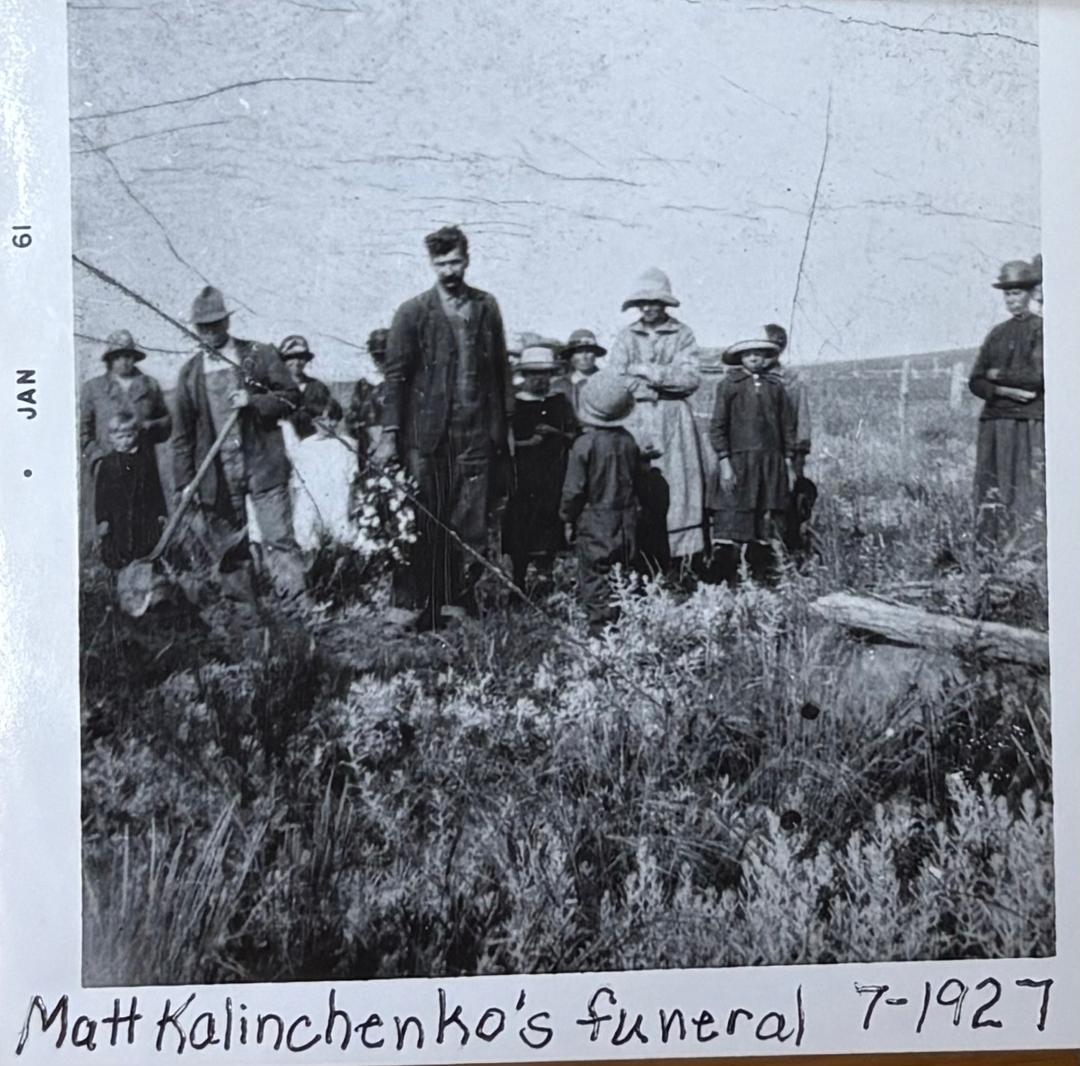
State’s Attorney J. S. Taylor did not believe the evidence was strong enough to support the charges. Interviews with Norton and his neighbors had been conducted, and although there were discrepancies in Norton’s account of his whereabouts, they fell short of a murder case. Stolen beef hides at Matt’s home drew scrutiny in case there was a broader criminal context, but Katie said Norton had given her the hides four years earlier, and no connection to the killing was found. Matt was last seen by his friend John Kukla, son of the farmer who found his body. Matt was supposed to stay home that warm spring day with his sisters while his mother went to get seed wheat, but he and John slipped out to make a quick trip along Matt’s trap lines. Matt made extra money by working for Norton during threshing season and by trapping rabbits. The boys were together until about 4:00pm, parting at the creek crossing, each heading home. A week before Matt disappeared, Norton had given him a pair of new shoes which he was wearing when he left that day. These were not the shoes on his feet the day his body was found. Weather and time had destroyed most of the physical evidence, and Taylor felt the circumstantial case could not prove guilt beyond a reasonable doubt. On July 16, 1927, Norton was released.
Three years later in late 1930, Jacobson found himself investigating another heinous crime – the infamous Haven family murders. Jacobson was persistent and meticulous in the investigation. He knew things in the disappearance of the family did not add up. His perseverance resulted in the confession of Charles Bannon to the six murders. Again, the community was outraged. Jacobson had moved Bannon to the Williams County jail because it was more secure. Jacobson’s term ended on December 31, and once more term limits prevented another run. The new sheriff, Syvert Thompson, moved Bannon back to the jail in Schafer for his upcoming arraignment. On January 29, 1931, a little after midnight, Bannon was forcibly removed from the jail by a masked mob and hung from a nearby bridge. When Jacobson was awakened and told of the lynching, he responded that he had dreamt this would be Bannon’s fate.
Epilogue
The murder of Matt Kalinchenko was never solved, but he is not forgotten. His descendants know about “Uncle Matt” and keep his memory alive. Katie received a phone call before her death in 1967, from an unknown person in Minnesota. The caller told her a friend of his had made a death bed confession to Matt’s murder. He said the killing occurred as they were fighting over trap lines. The family never believed this story.
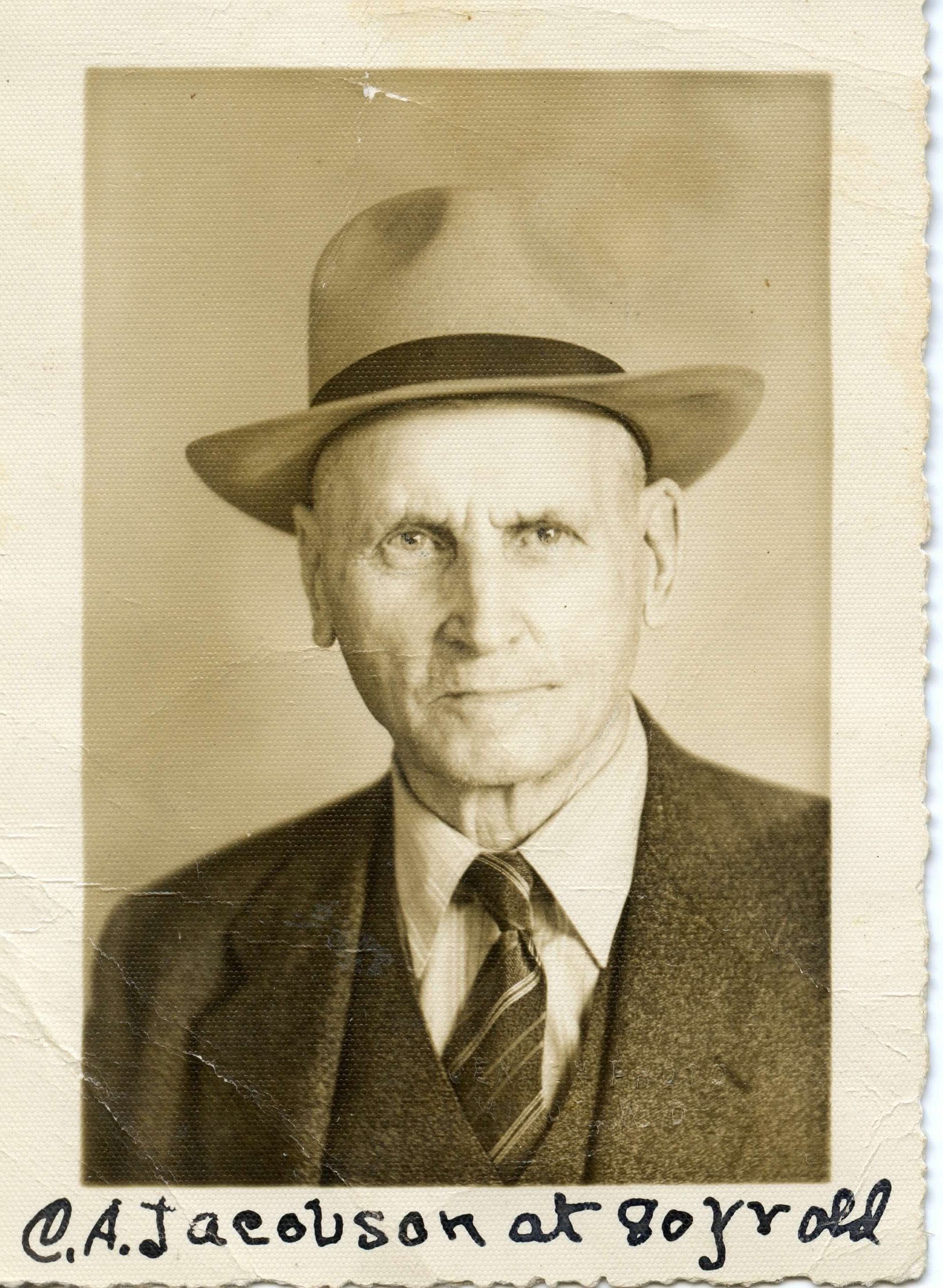
Charles Anders Jacobson died on September 9, 1943. For forty-four years he had worked as a lawman in varying capacities across North Dakota. The last case of his career, the murder of the Haven family and lynching of Charles Bannon, has been immortalized in print and film. After Jacobson’s retirement, newspaper stories were written about his unique record of being elected sheriff for multiple terms in two North Dakota counties. Jacobson remains a truly legendary frontier lawman.
A special thank you to Bruce Hetland and Linda Mae Jenner
Photographs courtesy of Bruce Hetland and Linda Mae Jenner
For more information on the Haven Family murders and lynching of Charles Bannon see The Cowboy Chronicle, Volume 25 Issue 6 Published November 2021 here on the Writi’n for the brand website.
References and Resources:
Conversations and Notes from:
- Bruce Hetland (great grandson of C.A. Jacobson,
- Linda Mae Jenner (granddaughter of Katie Kalinchenko,)
- Taylor Hoffman (great, great granddaughter of Katie Kalinchenko)
Grafton Police Dept., Grafton, North Dakota, via Facebook Messenger January 15, 2026, answer to question about C A Jacobson’s time as Chief of Police.
Books:
North Dakota History and People: Outlines of American History, Volume 3, S.J. Clark Publishing Co., Chicago, 1917
Ukrainians in North Dakota in their Voices, Agnes Palanuk, c July 2011
From Dreams to Reality, Hedvig Clausen Svore, published by the Bismarck Tribune, c. 1954
Newspapers:
https://www.findagrave.com/memorial/158867853/warfolmey-kalinichenko
https://www.findagrave.com/memorial/124359581/matt-kalinchenko
https://www.newspapers.com/article/grand-forks-herald/185180959/
https://www.newspapers.com/image/1127288748/
https://www.newspapers.com/image/1128040306/
https://www.newspapers.com/image/1128337515/
https://www.newspapers.com/image/851830877/
https://www.newspapers.com/image/1133540643/
https://www.newspapers.com/image/1133835502/
https://www.newspapers.com/image/71267372/
https://www.newspapers.com/image/77790851/
https://www.newspapers.com/image/604074992/
https://www.newspapers.com/image/1134025038/
https://www.newspapers.com/image/1130308816/
https://www.newspapers.com/image/1126808195/?match=1&clipping_id=new
https://www.newspapers.com/image/1030549407/?clipping_id=185181147tr
https://www.newspapers.com/image/1030548935/?clipping_id=new
https://northdakotacowboy.org/wp-content/uploads/2022/08/CowboyChronicle_Nov2021_Final1.pdf
You May Also Like

Biography of Charles Franklin Martell

Biography of Andrew J. Nohle
