Rodeo and the American Spirit
This article is dedicated to the memory of Dora Jane Martell Brockway (1939-2026). Dora served as a District 13 trustee beginning during the tenure of the NDCHF’s first Executive Director, Darrell Dorgan until her death. She was a summer volunteer at the Hall and a contributor to the Cowboy Chronicle. Throughout her life, Dora was a steadfast advocate for preserving and sharing the heritage of North Dakota and the American West. Her love for that heritage, and for the state she called home, never wavered.
Few traditions are more uniquely American than rodeo. Rising from the everyday work of cowboys, it grew into more than just a competition of riding and roping. Rodeo evolved into a celebration of the values that have long defined our nation’s character—individualism, self-reliance, perseverance, faith, patriotism, and community. When Americans gathered to celebrate Independence Day across the frontier in the nineteenth century, they did more than listen to speeches, wave flags, and light bonfires. Cowboys tested their skills against one another in horsemanship, roping, and riding contests. As these informal gatherings evolved into organized events, rodeo remained deeply connected to the nation’s history and culture.
Deadwood, Dakota Territory – July 4, 1876
The new city of Deadwood was celebrating. The Black Hills Weekly Pioneer had reported that it would be a “celebration in grand style.” Even though Dakota Territory was not yet officially part of the Union, the planning committee had raised the funds to have a full day of activities starting with a 100-gun salute and the raising of a 100-foot flagpole in front of the speaker’s stand. There were speeches, readings, songs, bonfires, and anvil firing (a frontier practice of launching a heavy blacksmith’s anvil into the air using black powder), with celebrations going into the night. And there was a rodeo!
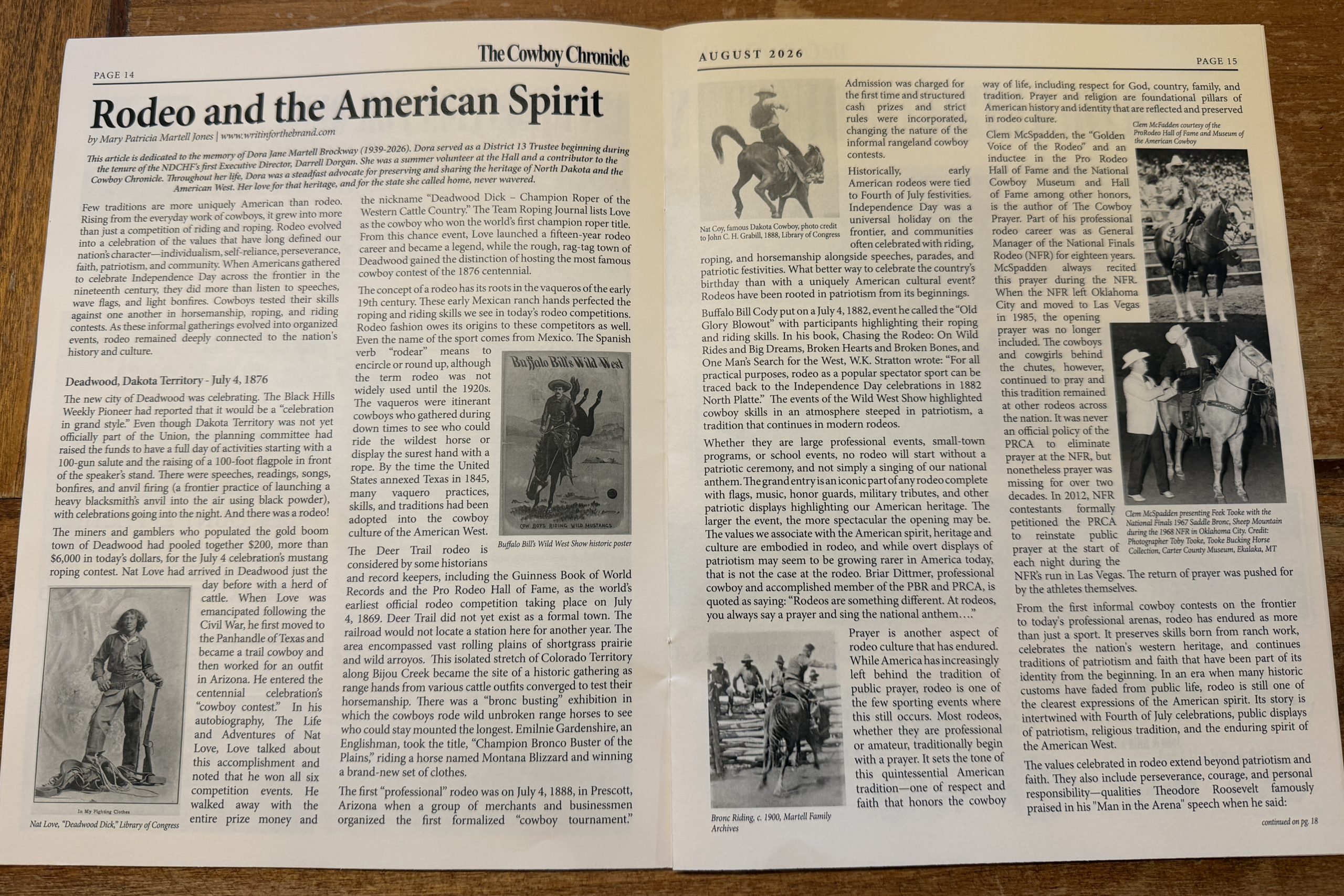
The miners and gamblers who populated the gold boom town of Deadwood had pooled together $200, more than $6,000 in today’s dollars, for the July 4 celebration’s mustang roping contest. Nat Love had arrived in Deadwood just the day before with a herd of cattle. When Love was emancipated following the Civil War, he first moved to the Panhandle of Texas and became a trail cowboy and then worked for an outfit in Arizona. He entered the centennial celebration’s “cowboy contest.” In his autobiography, The Life and Adventures of Nat Love, Love talked about this accomplishment and noted that he won all six competition events. He walked away with the entire prize money and the nickname “Deadwood Dick – Champion Roper of the Western Cattle Country.” The Team Roping Journal lists Love as the cowboy who won the world’s first champion roper title. From this chance event, Love launched a fifteen-year rodeo career and became a legend, while the rough, rag-tag town of Deadwood gained the distinction of hosting the most famous cowboy contest of the 1876 centennial.
Library of Congress
The concept of a rodeo has its roots in the vaqueros of the early 19th century. These early Mexican ranch hands perfected the roping and riding skills we see in today’s rodeo competitions. Rodeo fashion owes its origins to these competitors as well. Even the name of the sport comes from Mexico. The Spanish verb “rodear” means to encircle or round up, although the term rodeo was not widely used until the 1920s. The vaqueros were itinerant cowboys who gathered during down times to see who could ride the wildest horse or display the surest hand with a rope. By the time the United States annexed Texas in 1845, many vaquero practices, skills, and traditions had been adopted into the cowboy culture of the American West.
The Deer Trail rodeo is considered by some historians and record keepers, including the Guinness Book of World Records and the Pro Rodeo Hall of Fame, as the world’s earliest official rodeo competition taking place on July 4, 1869. Deer Trail did not yet exist as a formal town. The railroad would not locate a station here for another year. The area encompassed vast rolling plains of shortgrass prairie and wild arroyos. This isolated stretch of Colorado Territory along Bijou Creek became the site of a historic gathering as range hands from various cattle outfits converged to test their horsemanship. There was a “bronc busting” exhibition in which the cowboys rode wild unbroken range horses to see who could stay mounted the longest. Emilnie Gardenshire, an Englishman, took the title, “Champion Bronco Buster of the Plains,” riding a horse named Montana Blizzard and winning a brand-new set of clothes.
The first “professional” rodeo was on July 4, 1888, in Prescott, Arizona when a group of merchants and businessmen organized the first formalized “cowboy tournament.” Admission was charged for the first time and structured cash prizes and strict rules were incorporated, changing the nature of the informal rangeland cowboy contests.
Historically, early American rodeos were tied to Fourth of July festivities. Independence Day was a universal holiday on the frontier, and communities often celebrated with riding, roping, and horsemanship alongside speeches, parades, and patriotic festivities. What better way to celebrate the country’s birthday than with a uniquely American cultural event? Rodeos have been rooted in patriotism from its beginnings.
Buffalo Bill Cody put on a July 4, 1882, event he called the “Old Glory Blowout” with participants highlighting their roping and riding skills. In his book, Chasing the Rodeo: On Wild Rides and Big Dreams, Broken Hearts and Broken Bones, and One Man’s Search for the West, W.K. Stratton wrote: “For all practical purposes, rodeo as a popular spectator sport can be traced back to the Independence Day celebrations in 1882 North Platte.” The events of the Wild West Show highlighted cowboy skills in an atmosphere steeped in patriotism, a tradition that continues in modern rodeos.
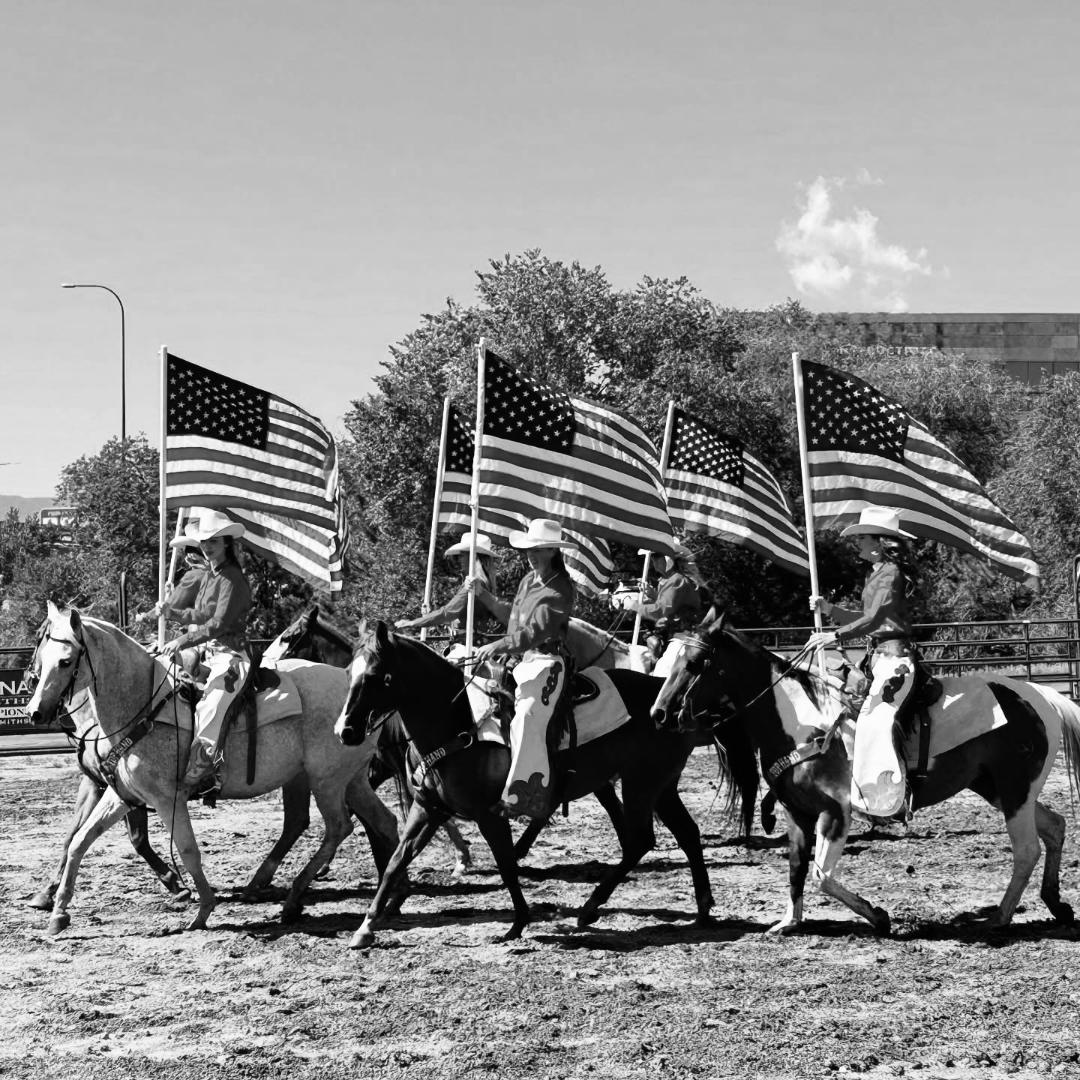
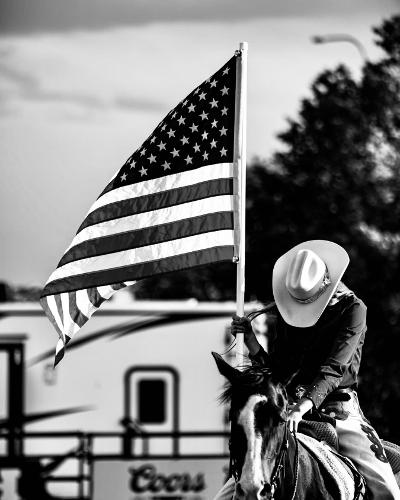
Whether they are large professional events, small-town programs, or school events, no rodeo will start without a patriotic ceremony, and not simply a singing of our national anthem. The grand entry is an iconic part of any rodeo complete with flags, music, honor guards, military tributes, and other patriotic displays highlighting our American heritage. The larger the event, the more spectacular the opening may be. The values we associate with the American spirit, heritage and culture are embodied in rodeo, and while overt displays of patriotism may seem to be growing rarer in America today, that is not the case at the rodeo. Briar Dittmer, professional cowboy and accomplished member of the PBR and PRCA, is quoted as saying: “Rodeos are something different. At rodeos, you always say a prayer and sing the national anthem….”
Prayer is another aspect of rodeo culture that has endured. While America has increasingly left behind the tradition of public prayer, rodeo is one of the few sporting events where this still occurs. Most rodeos, whether they are professional or amateur, traditionally begin with a prayer. It sets the tone of this quintessential American tradition—one of respect and faith that honors the cowboy way of life, including respect for God, country, family, and tradition. Prayer and religion are foundational pillars of American history and identity that are reflected and preserved in rodeo culture.
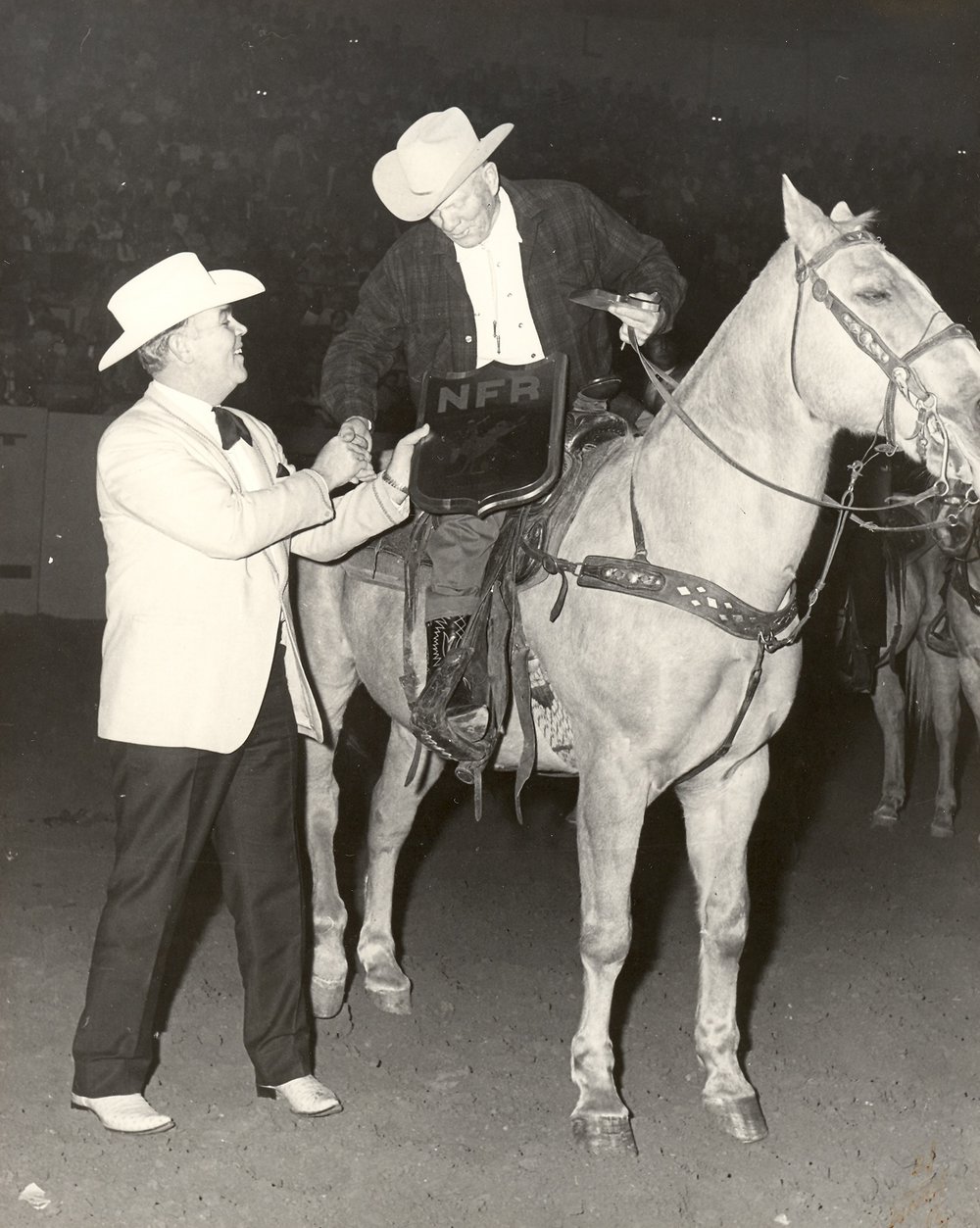
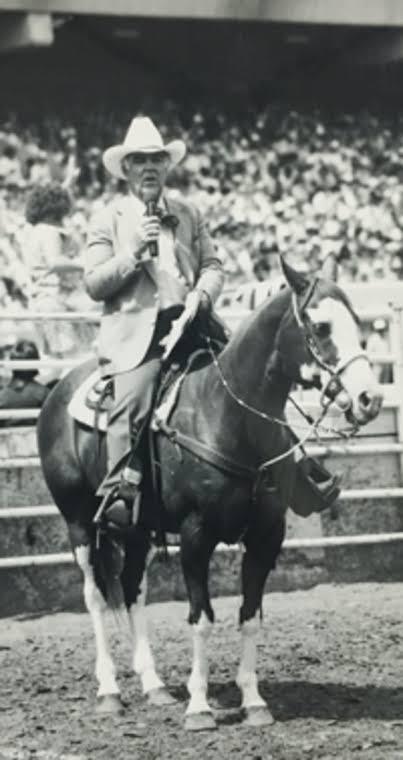
Clem McSpadden, the “Golden Voice of the Rodeo” and an inductee in the Pro Rodeo Hall of Fame and the National Cowboy Museum and Hall of Fame among other honors, is the author of The Cowboy Prayer. Part of his professional rodeo career was as General Manager of the National Finals Rodeo (NFR) for eighteen years. McSpadden always recited this prayer during the NFR. When the NFR left Oklahoma City and moved to Las Vegas in 1985, the opening prayer was no longer included. The cowboys and cowgirls behind the chutes, however, continued to pray and this tradition remained at other rodeos across the nation. It was never an official policy of the PRCA to eliminate prayer at the NFR, but nonetheless prayer was missing for over two decades. In 2012, NFR contestants formally petitioned the PRCA to reinstate public prayer at the start of each night during the NFR’s run in Las Vegas. The return of prayer was pushed for by the athletes themselves.
From the first informal cowboy contests on the frontier to today’s professional arenas, rodeo has endured as more than just a sport. It preserves skills born from ranch work, celebrates the nation’s western heritage, and continues traditions of patriotism and faith that have been part of its identity from the beginning. In an era when many historic customs have faded from public life, rodeo is still one of the clearest expressions of the American spirit. Its story is intertwined with Fourth of July celebrations, public displays of patriotism, religious tradition, and the enduring spirit of the American West.
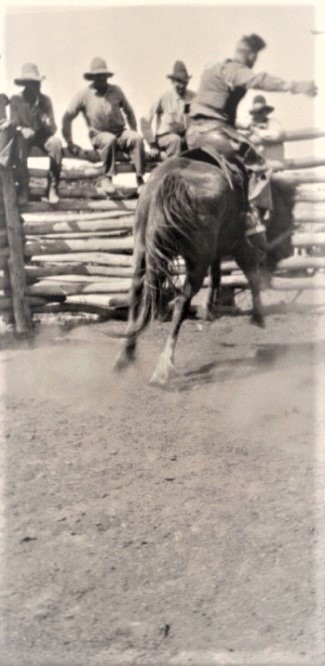
The values celebrated in rodeo extend beyond patriotism and faith. They also include perseverance, courage, and personal responsibility—qualities Theodore Roosevelt famously praised in his “Man in the Arena” speech when he said:
“It is not the critic who counts; not the man who points out how the strong man stumbles, or where the doer of deeds could have done them better. The credit belongs to the man who is actually in the arena, whose face is marred by dust and sweat and blood; who strives valiantly; who errs, who comes short again and again, because there is no effort without error and shortcoming; but who does actually strive to do the deeds; who knows great enthusiasms, the great devotions; who spends himself in a worthy cause; who at the best knows in the end the triumph of high achievement, and who at the worst, if he fails, at least fails while daring greatly, so that his place shall never be with those cold and timid souls who neither know victory nor defeat.”
While Roosevelt was not speaking of the rodeo arena, rodeo riders have adopted his words because they fit their sport’s nature – one defined by individualism, self-reliance, freedom, and the ability to overcome obstacles with grit and determination. Those same qualities have long been associated with the American character itself. More than a century after cowboys first gathered at Fourth of July celebrations to test their skills, rodeo remains a living connection to the values, traditions, and heritage that helped shape the American West.
The Cowboy Prayer by Clem McSpadden
“Our Gracious Heavenly Father, we pause in the midst of this festive occasion to say thank you for all of Your blessings. We thank You for the privilege of being a part of this great sport of rodeo. We ask, Father, that You watch over these contestants today. We do not ask for special favors, nor do we ask that the rough stock buck any less harder, or that the steers run any slower because we are riding them.
We only ask that You give us the courage to compete, the strength to try, and the wisdom to accept the judges’ decision with a smile, whether we win or lose. And Father, when our final ride is over, we make that long trek down into the great arena of life, where the grass grows green and the stirrups are always high, we ask that You, the Great Judge, will look down upon us and tell us our entry fees are paid. Amen.”
You May Also Like

Straight to the Horse’s Mouth

Just One More Ride
